Absentee And Online Bidding Pages That Answer The Phone For You
How to write one bidding page that explains in-person, absentee, phone and online bidding clearly enough to stop the same questions arriving by phone every sale week.
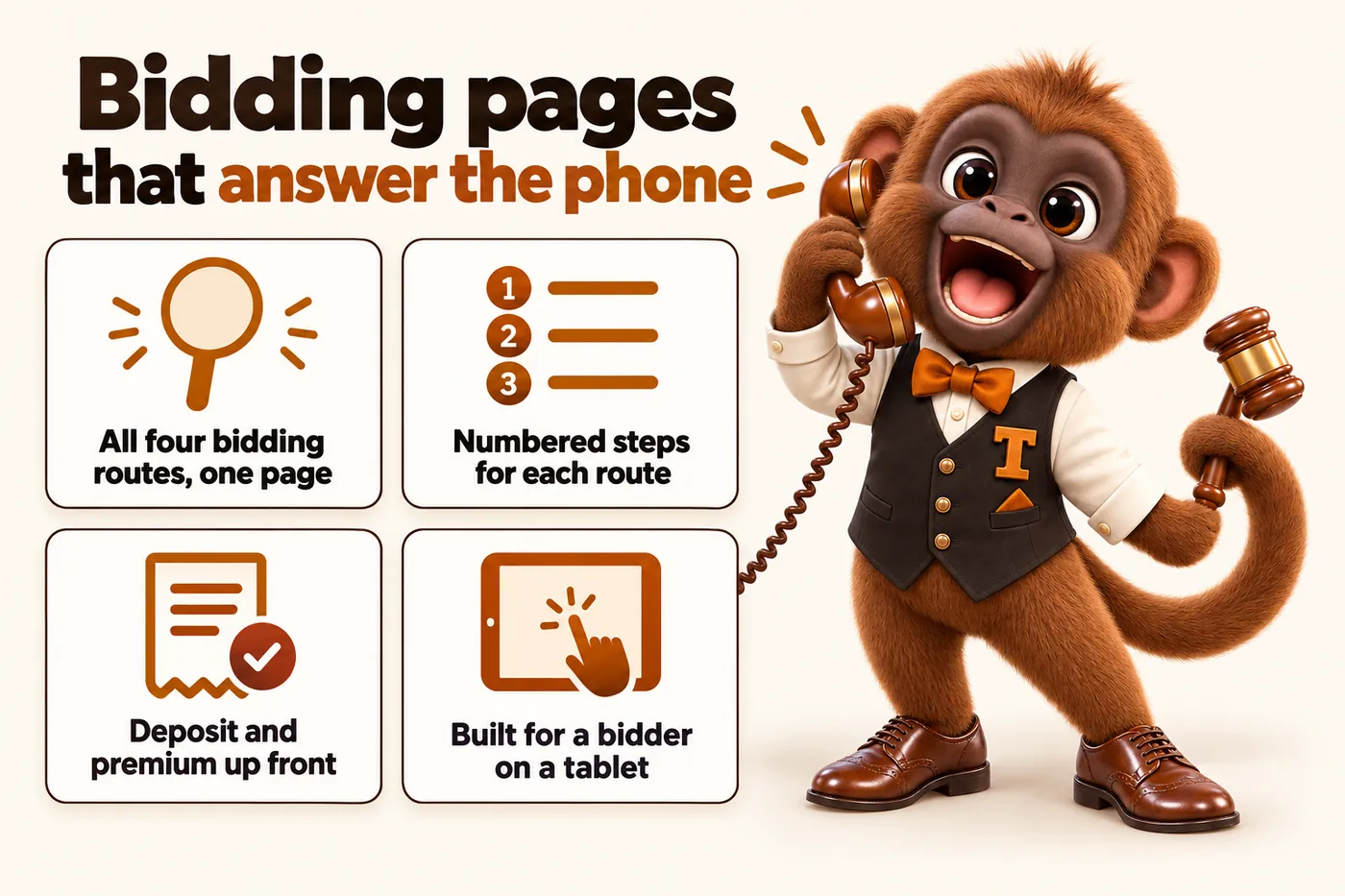
A bidding page answers the phone for you when it explains all four ways to participate in your sale, in plain numbered steps, on one page a first-time bidder can finish in about three minutes. Nearly every repeated call an auction house takes in the four days before a sale comes down to the same short list: how do I bid if I cannot be in the room, what does it cost on top of the hammer price, when do I have to be registered by, and how do I get the lot home. A page that answers those four questions in order removes most of that call volume without removing a single conversation you actually want to have.
This article is about how to build and write that page. It is not bidding advice, and nothing here tells you what your deposits, increments, reserves or premiums should be. Those are yours to set. The job of the website is to publish whatever you already decided, clearly enough that a bidder in another state on a tablet understands it before they pick up the phone.
Why one page removes the same calls every sale week
The calls repeat because the information is scattered. In most auction house websites, the absentee bid form lives in a PDF, the buyer’s premium lives in the terms page, the online platform lives behind a logo in the header, and the pickup window lives in the body copy of one sale listing. Every one of those facts exists somewhere on the site. None of them are in the place where a bidder is actually making a decision, which is the moment they have found a lot they want and realized they cannot be in the room on Saturday.
Scattered information produces a specific kind of phone call: not a question about a lot, which is a call worth taking, but a navigation question about your own website. Those calls arrive in a cluster in the last 48 hours before a sale, which is exactly when your staff are cataloging, photographing, setting up the preview and answering consignor questions. A single bidding page consolidates the answers into one place you can link from every lot, every sale listing, every email and every social post.
There is a second benefit that is easy to miss. When a bidder reads the whole process before registering, the registrations you do receive are better ones: the deposit is already understood, the premium is not a surprise at checkout, and the pickup window is not a problem discovered on Monday. Fewer surprises after the hammer falls means fewer unpaid invoices and fewer lots that sit in your building for two weeks.
What belongs on the bidding page and what does not
The bidding page explains how to participate. It does not try to be the sale calendar, the catalog, or the consignment intake page. Keeping those boundaries clean is what keeps the page short enough to read.
A useful test: if a fact changes every sale, it belongs on the sale listing. If a fact is true of every sale your house runs, it belongs on the bidding page. Preview times, addresses and lot counts change weekly. Your registration process, your premium structure and your payment methods usually do not. Put the stable facts on the bidding page and let each sale listing carry the ones that move.
The four bidding routes, written as plain steps
Most auction houses offer four ways to participate, and a bidder needs all four described on the same page so they can compare them. The comparison is the point. Someone who cannot attend in person is choosing between leaving a left bid, booking a phone line and bidding online, and they can only choose if all three are described with the same level of detail.
Route 1: In person with a paddle number
In-person bidding is the shortest section to write, because most of it happens at your registration desk rather than on your website. What the page owes the reader is the sequence and the paperwork, so nobody arrives at the preview without their identification.
- Arrive during the published preview window. Say when the preview opens and whether it runs the day before the sale, the morning of the sale, or both.
- Register at the desk and receive a paddle number. State what identification is required and whether a card on file or a deposit is taken at that point.
- Inspect the lots you care about. This is the sentence that sets expectations about condition: state plainly that lots sell as they stand and that the preview is the opportunity to inspect them.
- Bid by raising your paddle. Mention the increment structure in one line and link to wherever your full increment ladder is published.
- Settle at the cashier after the sale. Say whether settlement happens the same day, what payment methods are accepted, and when removal begins.
That is five steps and perhaps 120 words on the page. It is enough, because the in-person bidder is standing in front of a member of your staff who can answer anything else.
Route 2: Absentee bidding, also called a left bid
An absentee bid is a maximum you leave with the house before the sale, and the house bids on your behalf up to that limit. This is the route most often explained badly, because the houses that use it every day forget how counterintuitive it is to a first-timer. Two things need saying explicitly on the page: the bid is a ceiling rather than an offer, and the bidder frequently wins below it.
- Find the lot number in the catalog and note it exactly as printed, including any letter suffix on a split lot.
- Register as a bidder first. State whether absentee bidders go through the same registration as floor bidders and whether a deposit applies.
- Submit your maximum bid by the published deadline, using the form, email address or platform your house accepts. Say which of those is authoritative if a bidder uses more than one.
- Understand how your house executes the bid. Write one sentence explaining that the house bids in normal increments on the bidder’s behalf and stops when competition stops, so the hammer price is often lower than the maximum left.
- Know the tie rule and the reserve rule. Every house handles an identical pair of left bids and an unmet reserve differently. Publish yours instead of leaving it to be discovered.
- Wait for notification. Say when results go out and how, and whether a bidder hears from you if they did not win.
Step 5 is the one that saves the most argument. A bidder who leaves a maximum on a lot with a reserve above it is going to be disappointed on Sunday, and the only fair place to manage that is on the page before they bid.
Route 3: Phone bidding
Phone bidding suits high-value lots and bidders who want to react in real time without a screen, and it costs your staff a person per line, which is why almost every house limits it. Say so on the page rather than discovering it during the sale.
- Check whether the lot qualifies. Many houses accept phone bids only above an estimate threshold. If yours does, publish the threshold.
- Book the line in advance. State the cut-off, which is usually 24 or 48 hours before the sale, and give the email address or form that books it.
- Register and provide the same identification as any other bidder, plus a reliable number and a backup number.
- Leave a fallback left bid. This is the detail bidders appreciate most: if the call does not connect, the house executes a backup absentee bid rather than the bidder losing the lot to a dropped signal.
- Expect the call a few lots ahead. Say how many lots ahead your clerk usually calls, so the bidder is not sitting by the phone for three hours.
Route 4: Online bidding, live simulcast or timed
Online bidding splits into two very different formats, and a bidder needs to know which one your sale uses before they plan their Saturday. A live simulcast runs alongside the room in real time, so the online bidder competes against the floor as the auctioneer works through the catalog. A timed sale has no auctioneer calling in real time at all: lots close on a published schedule, often with a soft close that extends a lot’s clock when a late bid arrives.
- Confirm which format this sale uses. Put the format on the sale listing and repeat the definition of each format on the bidding page.
- Create an account on the platform your house uses, and register for this specific sale. Say clearly that a platform account and a sale registration are two separate steps.
- Wait for approval. Approval is not instant on most platforms, especially for a new account, which is why the registration deadline exists.
- Check the online premium. If your online buyer’s premium differs from the floor premium, this is the step where it must be stated.
- Bid, and watch the increments. For a live simulcast, note that the auctioneer controls the pace and the floor can outbid an online bidder at any moment. For a timed sale, explain the soft close in one plain sentence.
- Check your invoice and the collection window as soon as the sale closes.
Where the third-party bidding platform fits
The third-party platform is where the bid is actually taken, and your website’s job is to get the bidder there prepared rather than to replace it. Almost no independent auction house takes live bids on its own domain. The house publishes lots and information on its own site and runs the live bidding through an established marketplace or bidding platform, because that is where the existing bidder pool and the payment handling already are.
That division of labor is a strength if you treat it deliberately. Your website is the page that ranks in search, the page a consignor judges you by, and the page that explains your process in your own words. The platform is the transaction. Problems only appear when the website treats the platform as an afterthought, with a logo in the corner and no explanation of what clicking it does.
Linking out without losing the visitor
Link out with a sentence of warning, a named destination and a clear route back. The failure mode is a bare button that throws a first-time bidder into an unfamiliar sign-up flow with no idea why they are there.
Four things make the handoff hold:
- Name the destination in the link text. “Register to bid on [platform name]” tells the visitor what is about to happen. “Click here” does not.
- Say what they will be asked for before they click: an email address, a card for verification, a phone number, an approval wait.
- Set expectations about timing. If approval takes hours rather than seconds, that sentence belongs next to the button, not in a follow-up email.
- Keep your own page reachable. Your terms, your pickup information and your phone number should be findable from the platform listing too, so a bidder who started on the platform can still find the house behind the sale.
If you run sales across more than one platform, which is common for houses mixing estate sale, farm and heavy equipment and industrial liquidation work, say which platform hosts which kind of sale. A bidder who registered for your equipment sale in April should not have to guess whether that account covers the benefit auction in June.
Registration deadlines and deposits in plain terms
A registration deadline exists because approvals take human time, and a deposit exists because the house carries the risk of an unpaid invoice. Both are reasonable, both feel arbitrary to a first-time bidder, and both are easier to accept when the page explains the reason in one sentence rather than stating the rule alone.
Write the deadline as an absolute time, including the time zone, not as a relative phrase. “Registration for the online sale closes at 5pm Central on the Friday before the sale” is unambiguous on a tablet in another state. “Register 24 hours in advance” invites an argument about when the 24 hours started.
For deposits, the page should answer four questions in order: how much, in what form, refundable under what conditions, and returned how quickly. A deposit that is a card authorization rather than a charge should say so in those words, because a bidder seeing a pending hold on a statement will otherwise call to ask. Government surplus and industrial liquidation sales often carry larger deposits than an estate sale, and if your house varies the deposit by sale type, the bidding page should say that the figure varies and the sale listing should carry the actual number.
One more sentence worth including: what happens to a registration that is approved but never used. Most houses simply release the hold, and saying so removes a small hesitation from a bidder who is not certain they can attend.
Buyer’s premium and payment methods, stated up front
State the buyer’s premium as a percentage, on the bidding page, above the fold, in the same words you use on the invoice. The buyer’s premium is the percentage added to the hammer price to reach what the buyer actually pays, and it is the single most common source of a surprised phone call after a sale. There is no version of hiding it that ends well, and a bidder who discovers it at checkout is a bidder who does not come back.
Four details make the difference between a premium that is understood and one that is merely published:
- The number itself, and whether it differs between floor bidding and online bidding. A different online rate is standard practice and completely fine to charge, as long as it is visible before the bid.
- Whether a discount applies for a particular payment method. Some houses reduce the premium for cash or cleared funds. If yours does, the condition and the deadline for it belong here.
- How sales tax interacts with the premium in the states you sell in, and what documentation an exempt buyer needs to provide, and by when.
- Any per-lot or per-invoice fee beyond the premium, such as a loading fee on heavy equipment or a documentation fee on titled items.
Payment methods deserve the same directness. List what you accept, what you do not accept, whether a card surcharge applies, and the deadline for settlement. If you do not accept personal cheques from an unknown buyer, say it on the page. It is a far better place to establish that than the cashier’s desk on a Saturday afternoon.
Pickup, removal and shipping expectations
Pickup is the part of a sale that most often goes wrong for a remote bidder, so the page should treat it as a first-class section rather than a footnote. An online bidder in another state has just won a lot they have never seen in a building they have never visited, and the two questions in their head are when they can get it and whether you will ship it.
Answer those in a fixed order:
- The removal window, with dates and hours. If the building must be cleared by a set date because it is an estate property rather than your own gallery, say so and explain what happens to lots left behind.
- What the buyer must bring. Their invoice, photo identification, and for farm and heavy equipment, their own loader, trailer, straps and labor.
- What your staff will and will not do. Whether you help load, whether a forklift is available, and whether loading assistance costs extra.
- Shipping in one honest paragraph. Most auction houses do not ship in house. If yours does not, say so plainly and name the third-party packers or freight brokers you have worked with, with a clear statement that the arrangement is between the buyer and that company. If yours does ship small lots, state the size limit and the turnaround.
- Titled and regulated items. Vehicles, trailers and some equipment involve paperwork that takes longer than a collection window. One sentence about how title transfer works at your house prevents a long call.
This section is also where you quietly protect yourself. A published removal deadline that a bidder read before bidding is a much stronger position than a deadline first mentioned on the invoice.
Making the page work for an older bidder on a tablet
Build the page for a bidder in their seventies reading on an iPad in a kitchen, because a meaningful share of estate sale and farm equipment bidders are exactly that. This is not a charitable consideration. It is the demographic that buys, and a page that is hard for them to read is a page that costs you registrations.
Type size, contrast and reflow
Set body text large enough to read without pinching and keep the contrast high. The W3C’s accessibility guidance asks for a contrast ratio of at least 4.5:1 for normal-size text and 3:1 for large text, which rules out the light grey body copy that page builder themes default to. The same guidance asks that text can be resized up to 200% without loss of content or function, which is precisely what happens when a bidder increases the text size on a tablet. A layout that breaks or hides its own buttons at that setting will lose that bidder silently.
Practical consequences for a bidding page: no body text below 16 pixels, no grey-on-grey, no text baked into an image of a sale bill, and no fixed-height boxes that clip their contents when the text grows.
Tap targets, forms and the absentee bid form itself
Make everything tappable big enough to hit on the first try. WCAG 2.2 sets a minimum target size of 24 by 24 CSS pixels with spacing rules around smaller targets, and a comfortable button on a bidding page should be considerably larger than that minimum. The absentee bid form is where this matters most, because it is the one place on the page a bidder types rather than reads.
A form an older bidder can complete without help has: a visible label above every field rather than a placeholder that vanishes when they start typing, a lot number field that accepts the format your catalog actually prints, a maximum bid field that does not reject a typed dollar sign or comma, large tap targets on every choice, and an error message that says what to fix rather than turning a field red. It also has a confirmation screen and a confirmation email, because a bidder who is not sure their left bid arrived will call to check, and that call is the exact call this page exists to prevent.
Structure a screen reader and a search engine can both follow
Use real headings in order, real lists, and a real table for the increment ladder. Assistive technology navigates by heading structure, so a page that skips from a top-level heading to a third-level one, or that fakes headings with bold text, is much harder to move through. The same structure is what lets a search engine understand the page, which is why accessibility work and search work so often turn out to be the same work.
Two pieces of markup earn their place on this page. FAQPage structured data on the bidding questions, with markup that matches the visible text word for word, helps the answers surface directly in search for people typing questions like “how does absentee bidding work”. And on each sale listing that links here, Event structured data built on the schema.org Event type gives search engines the date, location and status of the sale itself in a form they can read without guessing.
A short checklist before you publish
Run the page against this list before it goes live, ideally on a phone and a tablet rather than the laptop it was built on:
- All four routes appear, each with numbered steps rather than a paragraph.
- The registration deadline is an absolute time with a time zone.
- The deposit amount, form, refund condition and release timing are all stated.
- The buyer’s premium appears as a percentage, with the floor and online rates distinguished if they differ.
- Accepted and refused payment methods are both listed.
- The removal window, loading expectations and shipping position are written out.
- Every outbound link to the bidding platform names the destination and says what happens next.
- Body text passes a contrast check and survives a 200% text size increase.
- The absentee bid form sends a confirmation the bidder can see and keep.
- Nothing on the page contradicts the terms page, because both are generated from the same set of facts.
Item 10 is the one that decays fastest. When the premium changes, it must change everywhere at once, which is an argument for a site where those figures live in one place rather than being retyped into five pages.
Where to go from here
If your current site scatters these answers across a PDF, a terms page and a platform logo, the fix is a single well-structured bidding page linked from every lot and every sale listing. What that costs, on each of the three plans, is on the pricing page, with the one-time build fee invoiced only after the site is live.
If you would rather see the page than read about it, book a demo and we will walk through a bidding page built for a sale type close to yours, using your own routes, your own deadlines and your own premium structure. We build and manage the website. The sale, the terms and every rule on that page stay entirely yours.
Sources
Frequently asked questions
What is the difference between an absentee bid and a left bid?
They are two names for the same thing: a maximum bid you leave with the auction house before the sale, which the house executes on your behalf up to that limit. Some houses say absentee, some say left bid, and some print both on the same form. Your bidding page should state which term your house uses and then treat the other as a synonym so a bidder searching for either one lands in the right place.
Does an absentee bid mean I pay my maximum amount?
No. An absentee bid is a ceiling, not an offer. The house bids on your behalf in the normal increments and stops as soon as the competition stops, so the hammer price is often below the maximum you left. Every house sets its own rules for ties and for how a left bid interacts with a reserve, so read the terms your house publishes rather than assuming.
Do I have to register separately for online bidding if I already have a paddle number?
Usually yes, because the online platform is a separate system with its own account, approval step and sometimes its own deposit. A paddle number issued at the registration desk covers the room, not the simulcast. Your bidding page should say plainly whether your house treats the two registrations as one or as two, since this is one of the most common phone questions of the week.
Why does the buyer's premium need to be on the bidding page rather than only in the terms?
Because the buyer's premium changes the number a bidder is deciding on, and a bidder decides on the bidding page. Stating the percentage, whether it differs between floor and online bidding, and where sales tax sits relative to it prevents the most avoidable category of post-sale dispute. Keeping the same figure on the terms page and the bidding page means there is only ever one number to update.
Is this page a substitute for legal, bidding or licensing advice?
No. This article is about how to write and structure a web page, not about how to run a sale. GetAuctionWebsite builds and manages auction house websites and is not an auctioneer, appraiser, bonding provider or law firm. Your terms, deposits, premiums and bidding rules stay entirely yours to set with your own advisors.
Want a site like the one described here? Book a demo with GetAuctionWebsite